
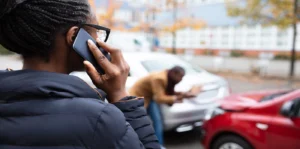
You’ve just been in a car accident. Once you’ve made sure everyone is safe, you’ll want to know what information you need to collect, what you should ask the other driver, and what you should avoid saying to protect your rights.
The information you gather in the minutes after a crash could become extremely important if you need to file an insurance claim, you discover that your injuries are more serious than you initially thought, or the other driver later disputes what happened.
Below is a quick checklist of what to collect after an Alabama car accident, followed by additional steps you should take in specific situations.
If you or a loved one has suffered a serious injury or wrongful death in an Alabama crash, contact the Birmingham car accident attorneys at Nomberg Law Firm for a free consultation to discuss your legal options.
What information should I collect immediately after a car accident?
If you’re still at the accident scene, start here. Once you’ve checked for injuries and moved somewhere safe when possible, use your phone to collect as much of the following information as you can:
- Other driver’s information. Get their full name, address, phone number, driver’s license information, and license plate number.
- Insurance information. Take a picture of the other driver’s insurance card so you have the insurer, policy information, and insured person’s name.
- Vehicle ownership. Ask whether the driver owns the vehicle. If not, get the owner’s name and contact information.
- Vehicle information. Record the make, model, color, license plate, and any identifying information for every vehicle involved.
- Witness information. Get the names and phone numbers of people who saw the crash. Don’t assume police will get everyone’s information before a witness leaves.
- Police information. Get the responding officer’s name, law enforcement agency, and crash report or case number.
- Photos and videos. Photograph all vehicles and damage from multiple angles, license plates, the overall crash scene, and where the vehicles ended up.
- Roadway details. Photograph traffic lights and signs, lane markings, skid marks, debris, construction, visual obstructions, and anything else that may help explain what happened.
- Location and time. Record the street, intersection, highway, direction you were traveling, and approximate time of the crash.
- Visible injuries. Photograph cuts, bruises, swelling, or other visible injuries when appropriate.
Don’t worry about taking perfect photographs. A wide shot showing the entire intersection can sometimes turn out to be just as useful as a close-up of a crushed bumper.
And don’t rely on remembering everything later. A serious crash is stressful, and details that seem obvious while you’re standing there can be surprisingly difficult to recall days or months later.
What should I ask the other driver after an accident?
Keep your conversation with the other driver brief and focused on exchanging information. You don’t need to discuss who caused the crash, explain what you were doing right before the crash, or say more than necessary about what happened.
Even an innocent comment on your part could potentially cause issues for your claim later if fault is disputed, so it’s best to say as little as possible.
Useful questions to ask the other driver immediately after a crash include:
- Can I see your driver’s license?
- Can I see your insurance card?
- What’s the best phone number to reach you?
- Is this your vehicle? (And if not: Who owns it?)
- Is this a company vehicle?
- Were you working when the accident happened?
- Were you driving for a rideshare or delivery service?
Those last few questions can be more important than they sound. If the driver was making deliveries, driving for a rideshare service, or performing work for an employer, another company or insurance policy may potentially be responsible for some or all of your damages.
For example, an employer may be liable for an accident caused by an employee who was driving as part of their job, while rideshare and delivery drivers may have additional insurance coverage that applies depending on what they were doing when the crash occurred.
It’s best to take pictures of the documents when the other driver permits it rather than relying only on handwritten notes.
What should I do if the other driver caused the accident?
Even if it seems obvious that the other driver caused the crash, don’t assume they’ll give their insurance company the same version of events later. If you’re able to do so safely, look for evidence that specifically shows what the other driver did wrong.
In addition to collecting the basic information above, you should:
- Look for cameras. Check nearby businesses, homes, intersections, parking lots, and doorbell cameras that may have captured the collision. Take a picture or make a note of where the cameras are located so the footage can be requested before it’s erased.
- Document unusual behavior. If you personally saw the other driver using a phone, stumbling, slurring their speech, throwing away an alcohol container, or behaving unusually, make a note of exactly what you observed and tell the responding officer.
- Document signs that the other driver was working. Photograph a company logo, DOT number, rideshare sign, delivery bag, or other indication that the driver may have been working when the accident happened.
- Ask witnesses what they actually saw. In addition to getting their contact information, you might ask, “Did you see what happened?” or “Did you see which vehicle had the green light?” Let them describe what they witnessed rather than telling them your version first. It’s also a good idea to ask for permission to record their answer while their memory is fresh.
- Pay attention to what the other driver says. They may voluntarily say something important, such as “I didn’t see the red light,” “I was looking at my GPS,” or “I was trying to answer my phone.” Write down their exact words as soon as possible rather than trusting yourself to remember them later.
Don’t try to get the other driver to admit fault or turn the conversation into an interrogation. Arguing about what happened may only make them defensive or less willing to talk.
Instead, focus on documenting any spontaneous statements they make and preserving the physical evidence that can help establish what happened later.
Can I record what the other driver says without their permission after a crash in Alabama?
Yes. Under Alabama Code § 13A-11-30, you can generally record a conversation you’re participating in without getting the other driver’s permission because Alabama only requires the consent of 1 participant to a private communication.
So basically, if you’re talking with the other driver and decide to record the conversation, your own consent generally satisfies that requirement.
The setting may provide additional protection. Alabama law defines a “private place” as somewhere a person may reasonably expect to be free from intrusion or surveillance and specifically excludes places accessible to the public or a substantial group of people.
A conversation taking place openly along a public roadway after an accident may therefore carry less expectation of privacy than one occurring in a private setting.
If you decide to record your conversation with the other driver after a serious accident, keep the original recording intact and don’t edit or delete any part of it. It’s also best not to send it to the insurance company or use it to confront the other driver before talking with your attorney.
Your lawyer can first determine whether the recording was legally made and whether it could help or potentially hurt your case.
If it can be used, your attorney can decide when and how to introduce it without unnecessarily revealing important evidence or giving the insurance company an opportunity to use something in the recording against you.
Personal Injury Checklist: 7 Documents Your Attorney Needs
What to bring to your first consultation with a personal injury lawyer.